Many healthcare organizations are “data rich but insight poor.” They collect KPIs every month, yet still react after cash has already slowed. That gap is the difference between reactive revenue cycle management and proactive RCM—and in 2026 it is where practices either protect margin or quietly lose it.
Outdated technology and lagging reports make the problem worse. By the time a dashboard shows aging AR or a denial spike, the underlying issue may have been building for weeks. Proactive revenue cycle management requires nearer-to-real-time reporting and analytics so leaders can prevent leakage instead of only explaining it after the fact.
Why reactive RCM is a hidden risk
Financial, regulatory, and staffing pressure are tightening at once. Practices that stay stuck in reactive mode often see:
- A/R aging spikes — By the time aging looks bad on a report, recovery is harder and costlier.
- Delayed denial trend visibility — Teams stay buried in appeals while the systemic cause keeps repeating.
- Lagging KPIs — Leadership knows what already happened, not what is about to happen next.
- Month-end financial surprises — Collections look “fine” until close reveals underpayments, rising denials, or stalled AR.
When those issues finally surface in financial reports, the practice may already be under real cash strain.
The financial cost of delayed insight
Delayed visibility is not just an operations inconvenience—it hits the P&L:
- Cash-flow volatility — Revenue swings because problems are corrected late instead of prevented early.
- Operational inefficiency — Staff time gets consumed by rework, appeals, and follow-up instead of clean first-pass work.
- Revenue leakage — Missed appeal windows, slow resubmits, and neglected patient balances quietly erase earned dollars.
- Undetected underpayments — Without expected-vs-actual reimbursement analytics, short pays get posted as “normal.”
Margins in most practices are too thin to “catch up later.” That is why proactive RCM with timely reporting matters.
What proactive revenue cycle management looks like
Proactive RCM helps organizations spot and correct risk before it delays payment, creates denials, or disrupts cash. In practice that usually includes:
- Financial forecasting — Better visibility into expected collections for budgeting and staffing decisions.
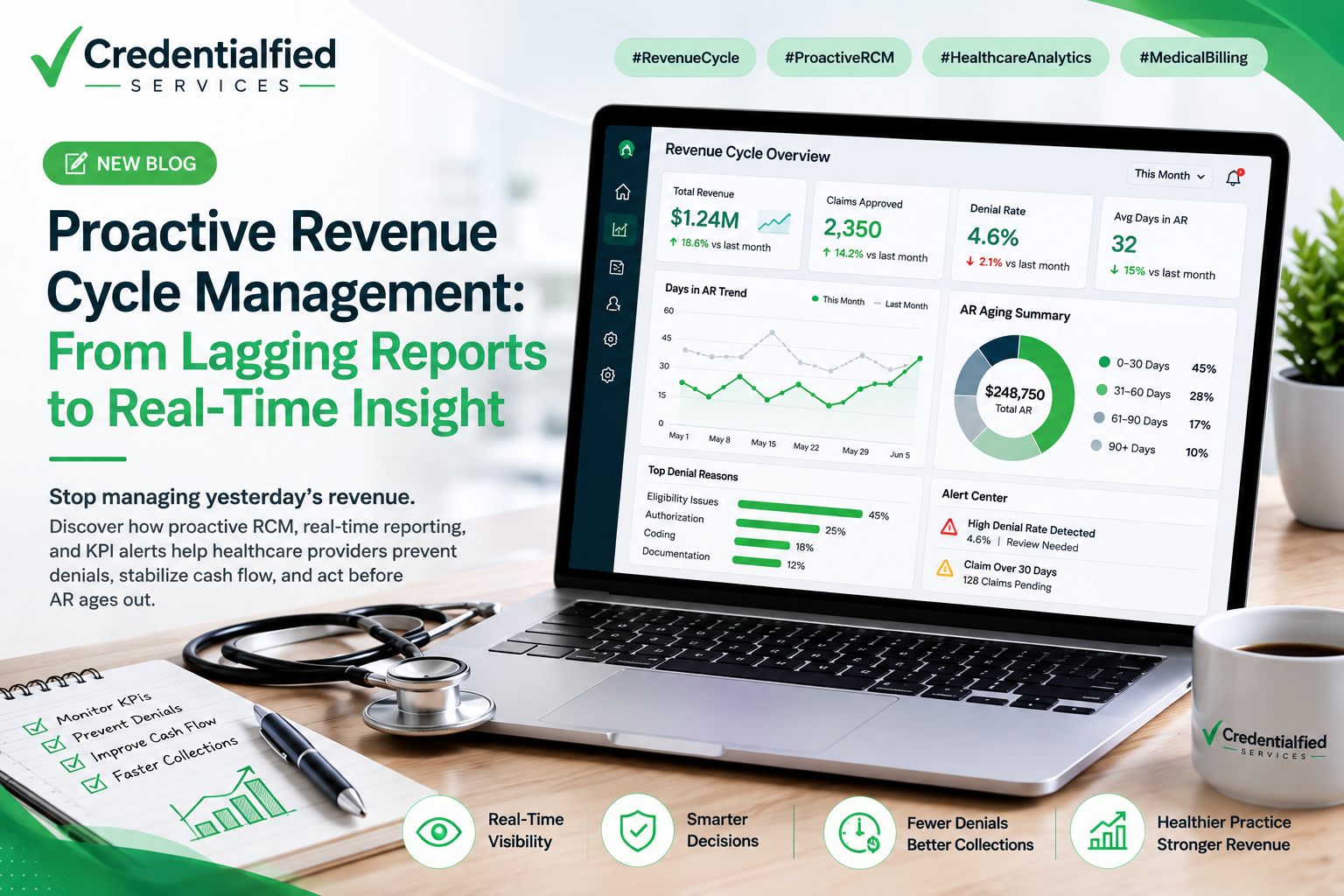
- KPI alerts — Automated signals when denial rates, charge lag, or aging buckets breach thresholds—without waiting for month-end.
- Near real-time dashboards — Daily (or frequent) updates so leaders can intervene while claims are still recoverable.
- Trend visibility by payer and specialty — Breakdowns that show where issues are emerging and why.
The goal shifts from fixing rejected claims after the fact to preventing the pattern that caused them.
Analytics as executive intelligence
When reporting is timely, RCM data becomes leadership decision support—not a historical archive. Strong practices use analytics to:
- Benchmark against internal targets and specialty norms
- Drive disciplined execution across eligibility, coding, denials, and AR
- Connect operational metrics to physician and practice financial outcomes
- Tie weekly work queues to cash and margin goals
In other words, analytics stop describing only the past and start informing the next 7–30 days of action.
How CredentialFied helps practices move from lagging to proactive
CredentialFied builds medical billing and credentialing around outcomes providers can track: clean-claim discipline, denial root-cause loops, AR prioritization, and leadership reporting that surfaces payer and specialty trends early—not after close.
Because credentialing status and billing accuracy are linked, we also help reduce “provider not eligible” and panel-related denials that reactive teams only discover after cash has already stalled.
Explore medical billing services, review how we connect enrollment and RCM on our services, or talk with CredentialFied about a reporting cadence built for action—not surprise.
Conclusion: stop managing yesterday’s revenue
Revenue cycle analytics should function as a decision-support system. Shifting from reactive to proactive RCM—with timely reporting, alerts, and specialty-aware follow-through—gives leaders the visibility to protect revenue while it is still recoverable. If your practice still waits for month-end to learn what went wrong, it is time to change the operating rhythm.