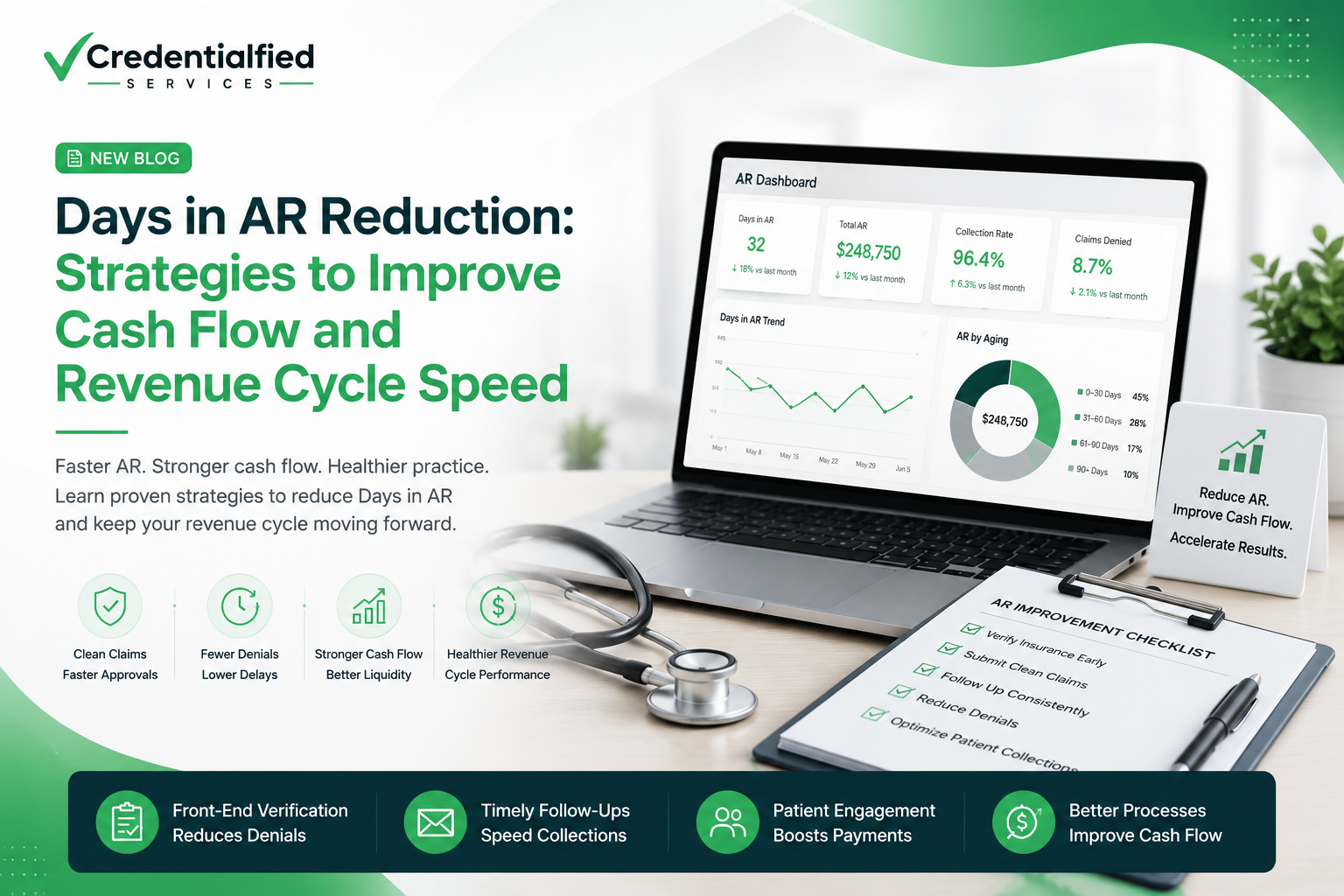
Days in accounts receivable (AR) is one of the strongest indicators of revenue cycle health. It measures the average time between claim submission and payment—and every day above benchmark is cash that should be in your operating account but is not.
Illustration: a practice with about $3 million in annual revenue and 45 days in AR can carry roughly $370,000 in outstanding receivables. Moving toward 30 days can free on the order of $125,000 in working capital that was always owed—but trapped in the billing pipeline.
Days in AR is rarely one broken step. It is the cumulative result of registration, eligibility, coding, submission, denials, posting, follow-up, and patient collections. A front-desk error can add 14–21 days. A coding denial can add 30–45. A missing auth can add 60–90. A patient balance left to statements alone can age 90–120 days—or become bad debt.
How to calculate days in AR
Days in AR = Total AR balance ÷ Average daily net charges. Average daily net charges = Net charges for the period ÷ Days in the period.
Example: $500,000 total AR and $20,000 average daily net charges = 25 days in AR. Calculate monthly and trend it—direction matters as much as the absolute number.
Useful benchmarks by practice type
- Primary care: best-in-class ≤ 25 days; average often 30–35; needs work above ~40
- Multi-specialty: best-in-class ≤ 28; average ~33–38; needs work above ~45
- Surgical specialty: best-in-class ≤ 30; average ~35–42; needs work above ~50
- Hospital-based (ER/hospitalist): best-in-class ≤ 35; average ~40–50
- Behavioral health: best-in-class ≤ 30; average ~35–45
Healthy AR aging distribution
A healthy aging report looks like a pyramid: most dollars in 0–30 days, less in each older bucket.
- 0–30 days: target ≥ 55% of AR
- 31–60: ≤ 25%
- 61–90: ≤ 12%
- 91–120: ≤ 5%
- > 120: < 3% (critical risk / timely filing exposure)
If older buckets outweigh 0–30, you have a systemic RCM problem—not a “slow month.”
Stage 1: Front-end verification (prevent AR before it starts)
Eligibility and demographic failures drive a large share of initial rejections. Strong protocols include:
- Pre-visit eligibility checks (often 48 hours ahead)
- Day-of re-verification at check-in (especially Medicaid)
- Demographic match to payer records (name, DOB, member ID)
- Authorization confirmation before the service is rendered
Practices that tighten front-end verification often see a multi-day AR improvement within about 60 days by eliminating reject–correct–resubmit loops.
Stage 2: Clean claim submission and charge lag
Clean claim rate is a top predictor of days in AR. Every point of improvement typically helps shave AR. Before submission, scrub:
- Patient demographics and insurance identifiers
- Rendering/billing NPI and taxonomy
- ICD-10 specificity and CPT/HCPCS + modifiers
- Place of service, units, and auth numbers when required
- Timely filing windows
Charge lag (DOS to claim submission) adds directly to days in AR. Best-in-class practices submit within 24–48 hours—not weekly batch dumps.
Stage 3: Denial management with speed
Denied claims are often the largest inflator of AR. Average resolution commonly runs 45–60 days from denial. A practical workflow:
- Identify and categorize the denial the day it posts
- Root-cause within 1 business day (correctable vs appeal vs write-off)
- Corrected claim or appeal within 1–5 days
- Follow up around day 14; escalate by day 30
- Close by day 45–60 with payment or approved write-off
Prevent the top drivers: eligibility/registration, prior auth, medical necessity, coding/bundling, duplicates, and timely filing.
Stage 4: Payment posting discipline
Unposted payments inflate AR and distort aging. Same-day ERA/EOB posting, daily reconciliation to deposits, accurate contractual adjustments (vs silent underpayments), and immediate patient-balance transfer all shorten the cash cycle.
Stage 5: Systematic AR follow-up
Ad hoc “when we have time” follow-up does not work. Prioritize:
- Critical: >90 days, material balances, filing deadlines approaching
- High: 61–90 days—status, holds, missing info
- Medium: 31–60 days—confirm receipt and adjudication
- Standard: 0–30 days—monitor expected payment dates
Every touch should end with an outcome and a next-action date—not a vague “pending” note.
Stage 6: Patient collections (the forgotten bucket)
Patient responsibility is growing and aging faster than many teams admit. Collect known copays/deductibles at check-in, then use text-to-pay, email, statements, and payment plans on a tight early timeline. Collection probability drops sharply after 60–90 days.
KPI dashboard to keep velocity visible
- Days in AR (weekly) — often target ≤ 30 for many physician practices
- Clean claim rate ≥ 98%
- First-pass resolution ≥ 95%
- Denial rate < 5%
- Charge lag ≤ 2 days; posting lag ≤ 1 day
- AR > 90 days < 10%; AR > 120 days < 3%
- Net collection rate ≥ 96%; patient collection rate ≥ 70%
A practical 90-day AR reduction plan
- Days 1–30: daily posting, same-day/next-day charge entry, 48-hour pre-visit eligibility
- Days 31–60: claim scrubbing, denial SLA (≈5-day turnaround), text-to-pay for patient AR
- Days 61–90: prioritized AR worklists, POS collection protocols, weekly leadership KPI review
Many practices starting near 45 days can aim for a 7–12 day reduction across 90 days, then continue toward 25–30 as processes mature.
How CredentialFied helps reduce days in AR
CredentialFied runs medical billing as a measurable cash program—eligibility support, clean-claim scrubbing, denial root-cause loops, posting discipline, AR prioritization, and leadership reporting—while aligning credentialing so panel status does not sabotage paid claims.
See our medical billing approach or book a conversation to benchmark your current days in AR.