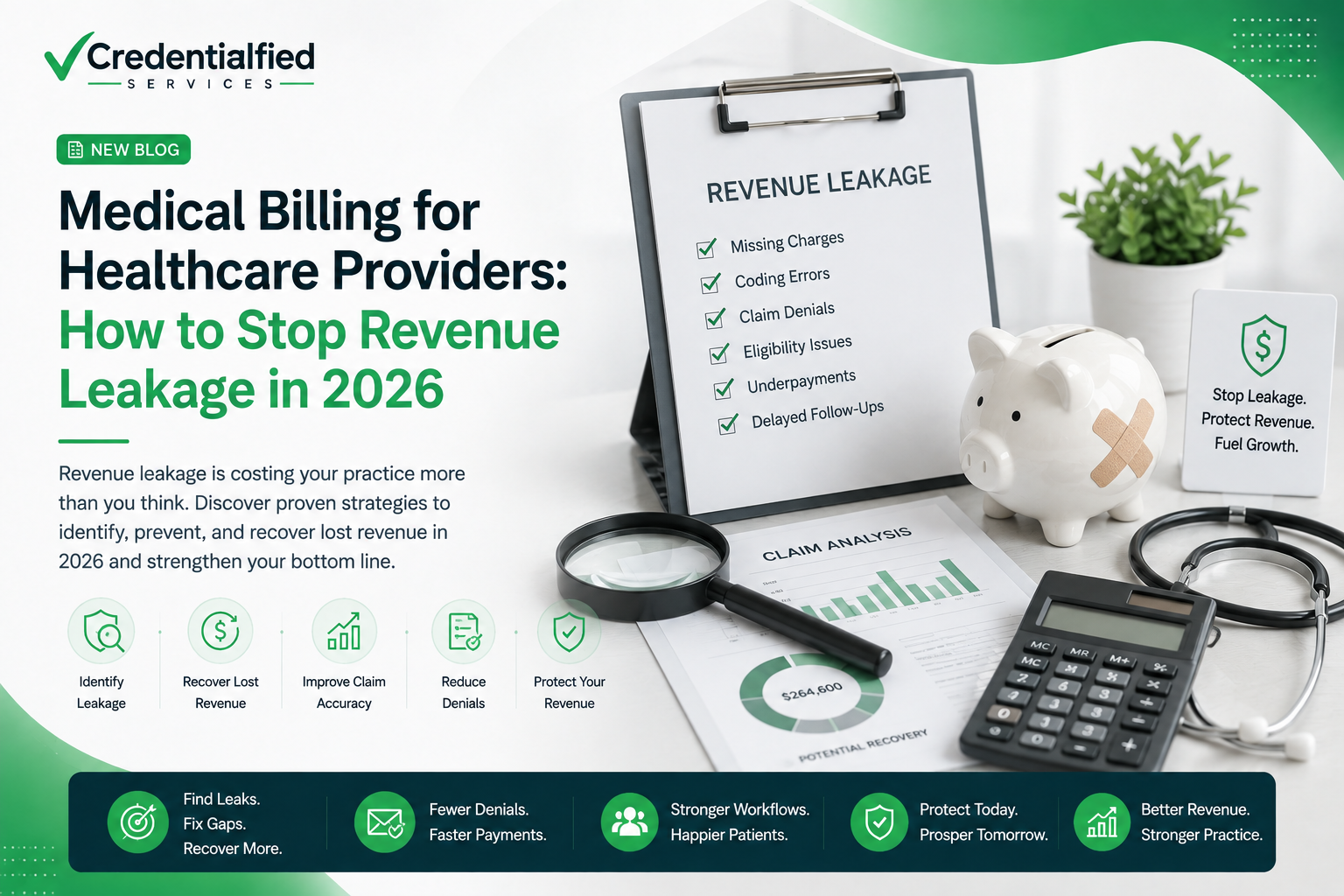
For most healthcare providers, the gap between services delivered and cash collected is not a mystery—it is a process problem. Eligibility misses, coding variance, weak claim edits, and slow denial follow-up quietly drain revenue every month. CredentialFied built this guide for practice leaders who want medical billing that is measurable, compliant, and built for U.S. payer reality.
Why medical billing still decides practice growth
Strong clinical care does not automatically convert into strong collections. Payers apply policy edits, National Correct Coding Initiative (NCCI) logic, authorization rules, and timely filing limits. When your billing workflow is reactive, you feel it as:
- Rising denial rates on otherwise billable encounters
- AR aging past 45–60 days with no owner on the worklist
- Underpayments that never get appealed
- Staff burnout from spreadsheet firefighting
Specialty-aware medical billing flips that pattern: scrub before submit, track root causes, and close the loop with reporting leadership can trust.
The clean-claim foundation every provider needs
First-pass acceptance is the cheapest KPI to improve. Before a claim leaves your stack, verify:
- Eligibility & benefits — coverage, plan type, and patient responsibility captured early
- Authorization / referral status — especially for high-cost procedures and imaging
- ICD-10 specificity — diagnosis specificity aligned to documentation
- CPT/HCPCS + modifiers — payer and specialty edits applied before submission
- NPI, taxonomy, and place of service — credentialing and billing data stay in sync
Practices that treat scrubbing as a checklist—not an afterthought—usually see fewer “preventable” denials within the first quarter of disciplined RCM.
Denial management that actually recovers cash
Not every denial is a write-off. Competitive medical billing teams categorize denials (eligibility, coding, authorization, bundling, timely filing, medical necessity) and assign owners with aging SLAs. The goal is twofold: recover what is collectible now, and stop the same denial from repeating next week.
Pair that with ERA posting discipline and secondary billing so secondary balances do not sit invisible in AR.
What CredentialFied brings to provider billing
CredentialFied supports healthcare providers with end-to-end revenue cycle support: claim submission and scrubbing, coding alignment, prior authorization support, payment posting, AR recovery, denial management, patient billing, and reporting tied to cash KPIs—not vanity dashboards.
If your practice is evaluating outsourcing, ask vendors for transparency on first-pass rates, denial trends by payer, and how credentialing status feeds claim accuracy. Billing and paneling are connected—broken credentialing shows up as billing friction.
Next step for practice leaders
Benchmark your current collection ratio, denial rate, and AR days. Then scope a billing engagement that matches your specialty mix—encounter-based, percentage of collections, or hybrid. CredentialFied helps providers tighten the path from encounter to payment so clinical excellence is matched by financial performance.
Start enrollment or talk to our team about medical billing built for healthcare providers.